
Your best tool is free
If you read these blogs regularly, I think I can take a fairly safe gamble in suggesting that you have at least SOME level of interest in improving your painting.
That subject can be quite sticky at times… online discourse on the matter is often dominated by a sea of recommendations for the next essential product you absolutely NEED if you want to be a better painter. Now farbeit for me to dare say that none of this is useful (because plenty of it is) but…
What if the best tool available to your improvement quest is one you already own, already know how to use and are just ignoring?
I won’t clickbait you here… I’m talking about eyes. Its safe to assume the majority of painters HAVE eyes, but of course any discussion about them does have to also take in to account that not all eyes are perfectly functional. We will get in to this later, but before we do so, I want to begin by talking about what we’re using instead of our eyes and why that’s a problem.
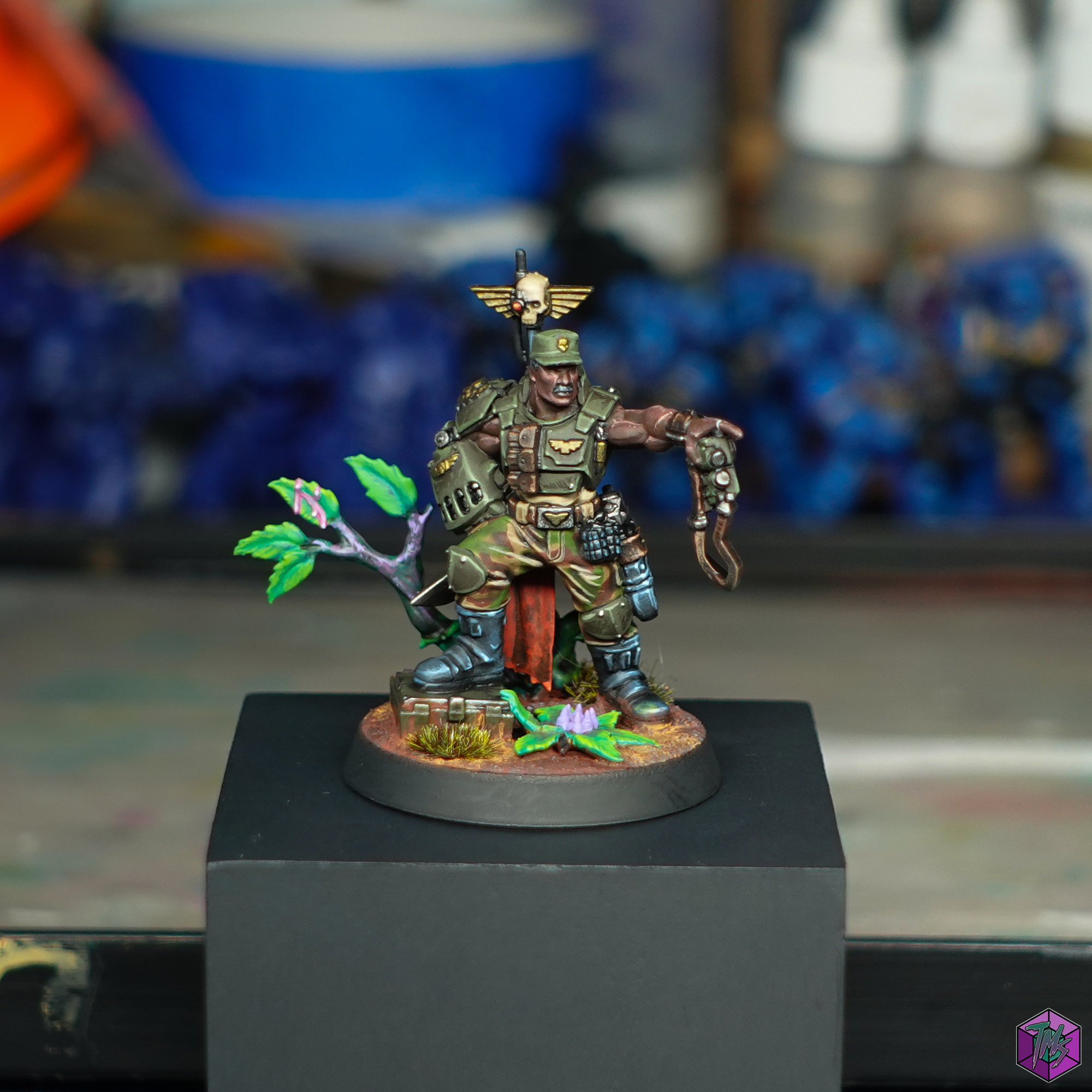
A Catachan Colonel from Warhammer 40K painted in a similar style to the Eavy Metal Studio
Over the course of our lives as painters, many of our minis will be painted with a method similar to the one above. We apply midtone basecoats, use a wash to shade, accent the hard edges to produce what we call highlights (they’re not, but more on that another time). It’s something similar to the Eavy Metal style. It’s procedural, it’s predictable, it’s consistent and it doesn’t require a ton of thinking, to achieve a result that most people are happy with…
And that’s exactly why it’s a hinderance to progress, and something I’ve quested hard over the last 10 years or so, to move away from in my painting.
You see, improvement requires practice, right? We all agree on that, I’m sure… but practice isn’t JUST repetition. Repetition is an essential part in committing things to memory and making them feel more natural and instinctive. For example, repetition is just about the only meaningful thing you can do to improve your brush control. But PRACTICE should also include challenge, goals, measurable progression…and I hate to say it, but recipe/procedure driven painting just can’t provide that to a degree I’ve found fulfilling.
When I teach classes, I am FERVENT in my passion for challenging my students at a perceptual and philosophical level. I don’t require anyone to agree with me… but I want to put them in an uncomfortable space where they have to reconsider things without relying on established norms, and ask themselves whether or not THEY need to change, in order to facilitate their improvement.
This might sound a little radical… but consider that I, myself, also come from a strictly Eavy Metal painting background and it wasn’t until over 20 years of painting, that I learned that I could do stuff like this:
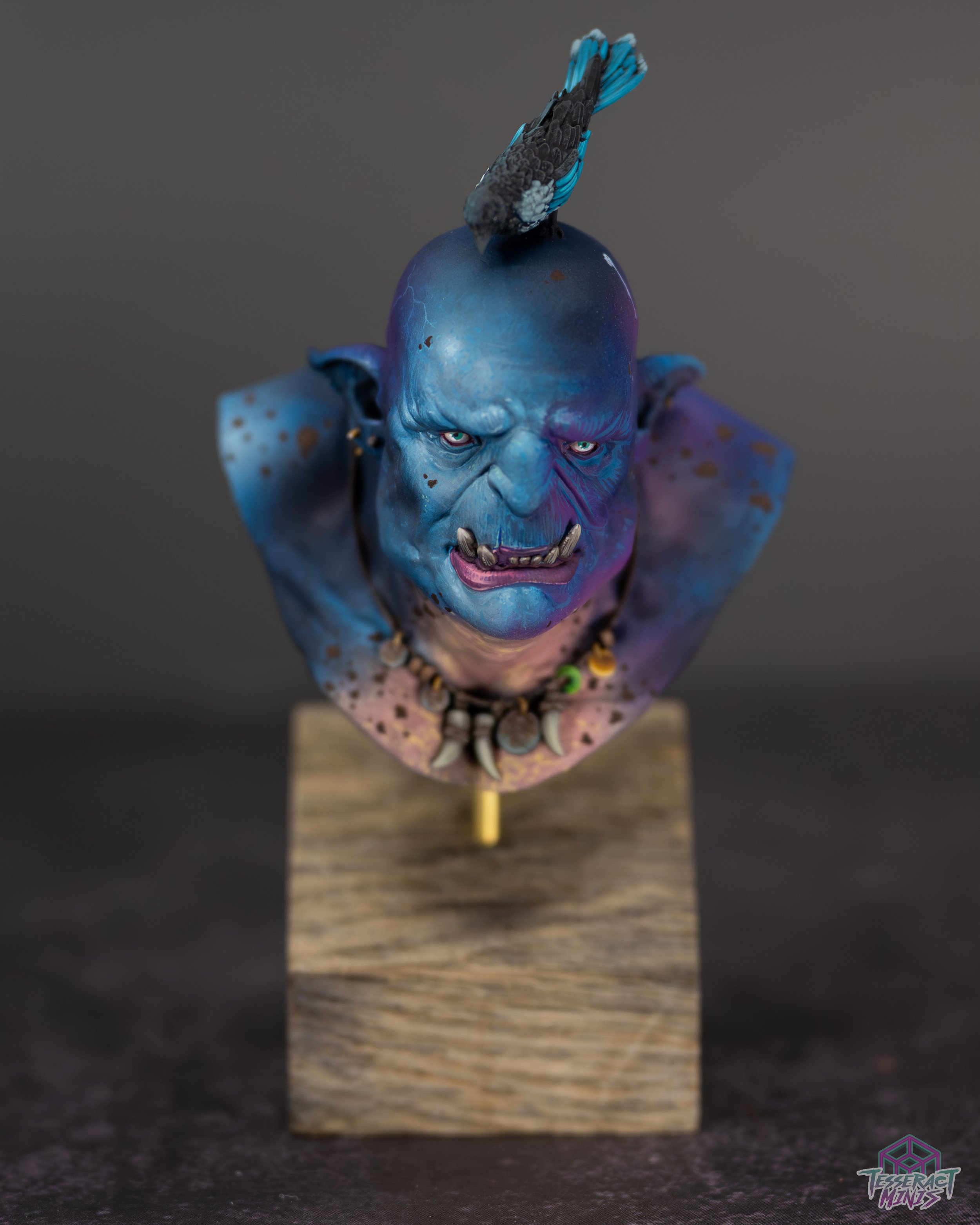
Ogre and Magpie, sculpted by Sara Glez, painted by Tesseract Minis
And that’s the part I want to help my students steer round… I don’t want them to experience the deathloop of grinding for marginal improvements, burning out, taking years off of painting, coming back and repeating the whole cycle again. I want them to build a PERSONAL skillset, that is targeted specifically at setting a desired outcome for a piece, and then delivering on that outcome. I want the improvements to be a natural, background thing that just happens, rather than the point of the quest. I want to set them up to make the miniatures THEY want to make.
That isn’t an easy mission… believe me, I STRUGGLED with how to communicate this for a long time. I struggled with how to plan classes, what to demonstrate, what to talk about. But as of next month, I’ve been teaching my online classes for a year, and that’s given me a lot of reps by this point… and lo’ and behold, one of the things that keeps coming up, again and again… is eyes.
In every other form of artistic painting… there are no recipes, no fixed procedures. Observation and a malleable approach to application are the tools that artists are taught, in order to achieve mastery. Colours aren’t named after things, they’re named after pigments. There are no catch all tricks or products designed to complete the process in as few steps as possible. None of these things come from the artistic drive to create beautiful painted miniatures. They’re driven by something that is (IMO) a little more sinister.
See… from a business perspective… certain executives very likely WANT you to paint your models quickly and to a standard that is “good enough” rather than the best you can do. They WANT to restrict your creative desires and funnel you into an output driven mode of thinking. They want you to get your models done, so that you want to buy more. This is why the hobby of miniature painting is usually tied so closely to the entirely separate hobby of miniature wargaming. The desire to field vast armies and regularly play games with them drives a sense satisfaction from just getting it done, rather than giving it your all. So procedures, recipes, narrow stylistic outcomes and silver bullet products become the norm… All neatly packaged as “making it more accessible” whilst steering people away from the creative core of what art is.
Crazy as it sounds… none of that is wrong. If that’s the world you like to live in and you’re having a good time, you’ve already found your passion and success. However, you’re also not who I’m talking to in this article. So… why did I use that word earlier, “sinister”? If I’m chill and happy with people doing the wargaming thing in its complete form and having a great time… why do I also think there’s some naughtiness going on?
Well… my perturbation comes from the fact that the very same folks making the silver bullets, pushing the idea of army painting being “the hobby” in its entirety and encouraging the procedural approach… seem to actively try to hide the very thing I’m most passionate about… Display painting. I don’t even think this is deliberate, if I’m honest… I think it’s cultural. But the painting being taught in stores ultimately bares almost no semblance whatsoever to the painting being done by those with an artistic interest in miniature painting.
Now before you say it… I am aware that the largest wargames manufacturer in the world ALSO hosts the largest display painting competition in the world… but lets just consider who actually ENTERS Golden Demon and who actually WINs it. Because yes… every year there’s an Eavy Metal style entry or two that makes the cut and performs well… but the OVERWHELMING majority of painters performing well at GD aren’t using Eavy Metal techniques. They’re not painting with GW paints a lot of the time. They’re using products like oil paints, airbrushes and wet palettes that GW doesn’t even make, acknowledge or incorporate in to their suggested workflow.
Simply put, Golden Demon, as a competition, couldn’t be further separated from the daily, business as usual approach to miniature painting that most people observe in their local stores and communities. It’s very easy to say that Golden Demon and other global painting competitions (because this isn’t really about GW and I’m not purposely trying to single them out) represent unobtainable levels of exceptionalism and dedication. It’s very easy to assume you haven’t got what it takes, or that there’s some mystical secret sauce you need to chase… but every single person who’s ever won a trophy at a major competition has almost definitely felt like that too. The only real difference is that they made a decision to commit themselves to doing something about it.
So with all that said… IS there a secret sauce? Well, yes… but it’s not a secret… it’s even closer than right before your eyes, because it literally IS your actual human eyes. It’s what thousands of years of artists have depended on, to improve their craft.
Lemme give you an example. Now I don’t know if this is STILL the recipe, but from back when I still painted Eavy Metal style, the prescribed method for Caucasian skin was as follows:
Basecoat in Bugmans Glow
Wash in Reikland Fleshshade
Highlight all raised surfaces with Cadian Flesh
Edge highlight with Kislev Flesh.
That may well have changed by now and I know there’s also the whole “contrast vs classic” thing further dividing how Citadel guides look, but it’s probably a fairly accurate proxy for how most people would approach that kind of skin still.
Now if you have those colours at hand, or if you care to look them up… what do you notice? It’s all peachy red colours at varying lightness (value), with the wash leaning slightly orange or chestnut.
Conversely, here’s what my palette currently looks like when I’m set up for Caucasian skintones:
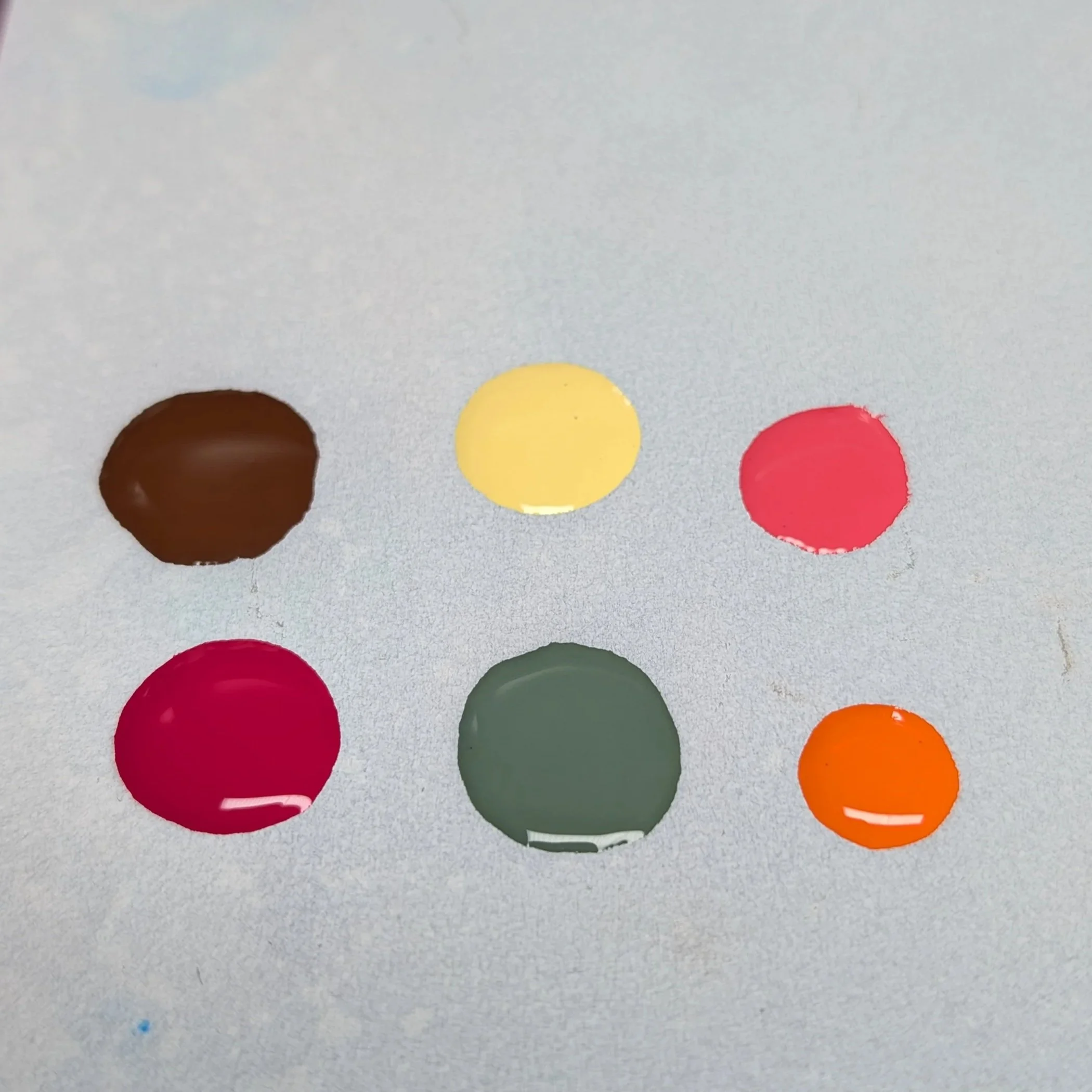
A Brown, a Pale Yellow, A Coral, A Dark Magenta, a Green Grey and a Bright Orange.
Really different right? Like… shockingly different… where are the oranges, browns and greys being worked in? Well… I don’t want to give away for free, instruction that I’ve charged others for, so if you really want to know the exact process, as I do it, sign up to Patreon and go back and find the skintones lessons from a few months back. What I will do however is explain a few things about the thinking behind this palette, as it pertains to today’s topic.
Now obviously I’m doing a lot of mixing… that’s a BIG part of learning to translate observation, and being able to get comfortable with learning paint behaviour and mixing properties is a VERY useful skill to practice… but essentially, the reason I’m choosing these specific tones is because they form a gamut that contains all of the tones I observe in real Caucasian skin, when I see it in the world around me.
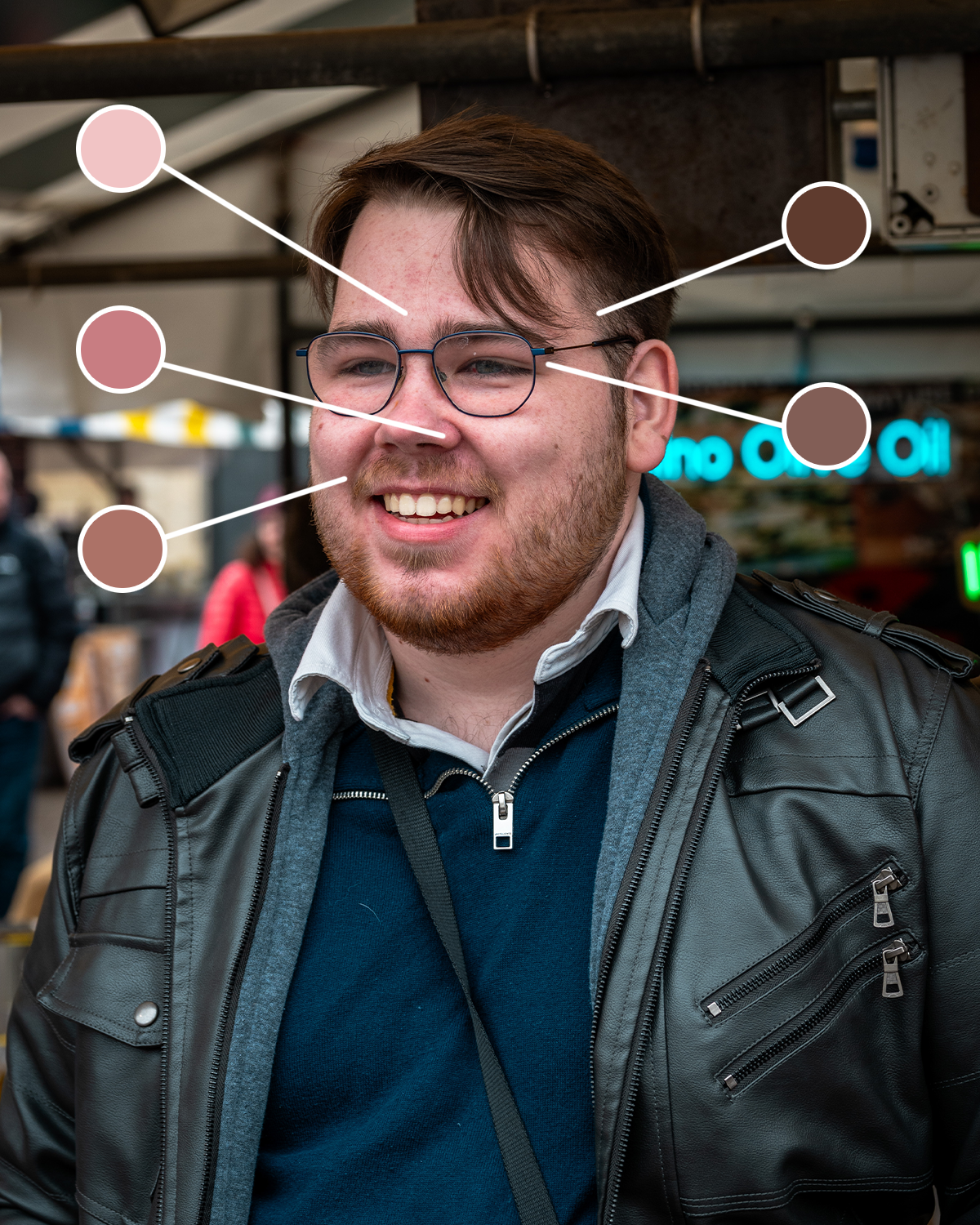
A Portrait I Shot in Cambridge, England.
In the above portrait I’ve isolated the main colours for you, using the colour picker in Photoshop. There’s a few things to note here, so I’ll break it down.
Firstly, there’s NO peachy creamy tones present AT ALL…and it’s actually pretty uncommon to see these tones, except in a few exceptional circumstances. If someone has very consistent skin, is both pale and unfreckled or is heavily made up, you’ll potentially see a gradient of peach… but most skin just doesn’t look like that. It has imperfections, it’s flushed, some folks eyes tend towards yellow or grey tones… skin is SO much more complex than three shades of peach and a chestnut shadow. Expressing it in miniature though, doesn’t have to be.
Notice that in my 6 tones (remember that’s only two more bottles of paint than the typical method), I can hit all of these, really easily. From a base of brown and dark magenta, mixed roughly equal, I can dip in to orange, pale yellow or green grey (or blue grey) and arrive very quickly at the actual tones I can observe in reality.
I should add at this point that the coral is a bit of an outlier, because I mainly use it for lips and lining eyes, it’s not generally essential to the actual workup of skin… but even with this considered, you can see it’s not massively complex from a procedural point of view, to work in a way that’s more grounded in reality.
That right there is the big takeaway I want to get over with this article. Using your eyes isn’t a god-level skill… it isn’t unobtainium. It’s not even crazy more complicated than what you’re most often taught to do… it’s just a different journey, with a different desired outcome. It’s placing creativity, observation and flexibility above consistency, simplicity and predictability. To paint this way, you are going to have to get comfortable with failing upward. You’re going to have to play with your paint a bit. You’re going to have to look at photos… but what you get out of it is SO powerful.
Being able to look at a piece of driftwood and say “Okay that’s desaturated browns, greens and cream tones” and then mix those tones from their constituent parts is so incredibly freeing. It allows us to make each piece look EXACTLY how we want it to. We don’t need to care about what the paint is called, because all we need is to understand what it looks like. We become masters of our own process, from day one, and set about the journey of mastering our output.
With any change, as adults, we naturally tend to evaluate the opportunity cost of implementing that change. Logically, those of you who don’t use methodology similar to mine, are probably reading this article and feeling “isn’t this a lot of arseache for something I’m gonna have to practice again from day one?” and you may well be right to do so. Realistically, whether or not changing your entire approach to how you build colour is worthwhile is going to fall down on how satisfied you are with your current results.
If you want to paint hundreds of models a year, play tens of games, and maybe now and then pick up a best painted army award at a tournament, then yes… procedural, recipe driven painting definitely IS right for you and you shouldn’t let me, or my results sway you from that. It’s important though to understand that painting this way, for most of us is exclusive of painting our best… the two just aren’t compatible. Even outside of technique, just based on time cost alone. Exceptions will exist… there are incredibly skilled painters who are also blisteringly fast… but it’s a rarity and it’s usually specific to the individual, not their technique.
Where I think this article could strike a chord though… is with the painter who got in to miniatures because they’re a crafty, artsy type. The painter who plays the games because their friends do, but never really feels super engaged by them. The painter who see’s the competition painters and the box art painters around the world and thinks “That looks really interesting.” Because chances are, if that sounds like you… it’s the artistic pursuit, rather than the functional one, that drives your desire to paint.
I’ll summarise in my typical slightly reductive but wholly heartfelt way, as I start to close out this article.
If you want to get better at miniature painting, instead of thinking about what to buy next, or how many models you painted this year so far… just go outside… look at the world, look at the things in it. Bring those things to the painting table and make a conscious effort to try to replicate them on your tiny people.
As a final closing statement, I said at the start that I also wanted to acknowledge those who are visually impaired, because whilst to able-sighted people it might seem strange, there’s actually a ton of folks in our hobby who’s eyes don’t function in a completely typical way.
For those folks, I want to say this…
Claude Monet had cataracts when he painted Water Lilies (probably his most famous and beloved piece).
John Linley Byrne - a hugely successful and famous comic book artist, is colourblind.
Guy from Midwinter Minis is red/green colourblind, and still mixes his paints all the time in his videos.
Whatever their condition, the eyes you have will always lead you to more exciting, fulfilling art, than painting by numbers. My own eyes have deteriorated drastically since my 20’s. Even in the last 2 years I’ve gone from occasionally needing my reading glasses to paint, to now needing them the whole time and having to battle headaches as a result. Realistically, in 20 more years, they likely won’t be able to do the things I can do now… but I’ll still trust them to take me to where I want to go, because creativity and expression are the very core of why I paint.
The world is an incredibly beautiful place, bringing it in to your painting doesn’t mean you have to copy it perfectly, but it does mean you get to draw on an infinitely deep pool of inspiration.
I think that’s pretty cool.
Thanks for reading, and I’ll see you next time.
Stu