
The Final Word in BrushCare?
In any hobby, pursuit or interest, people like to feel like an insider. It’s natural, right? Feeling like you have that secret knowledge, that’s normally locked away to everyone except industry professionals is a great feeling, and the need to share it can often feel noble.
But what if these “insights” have so long to propagate, and are so unchecked, that an entire culture of “knowledge” grows from… well lets just say dubious factual origins?
I don’t think for a second that miniature painting is the worst culprit for this, but there is one particular field of what I like to call “bro-science” that upsets me a bit… Brushcare.
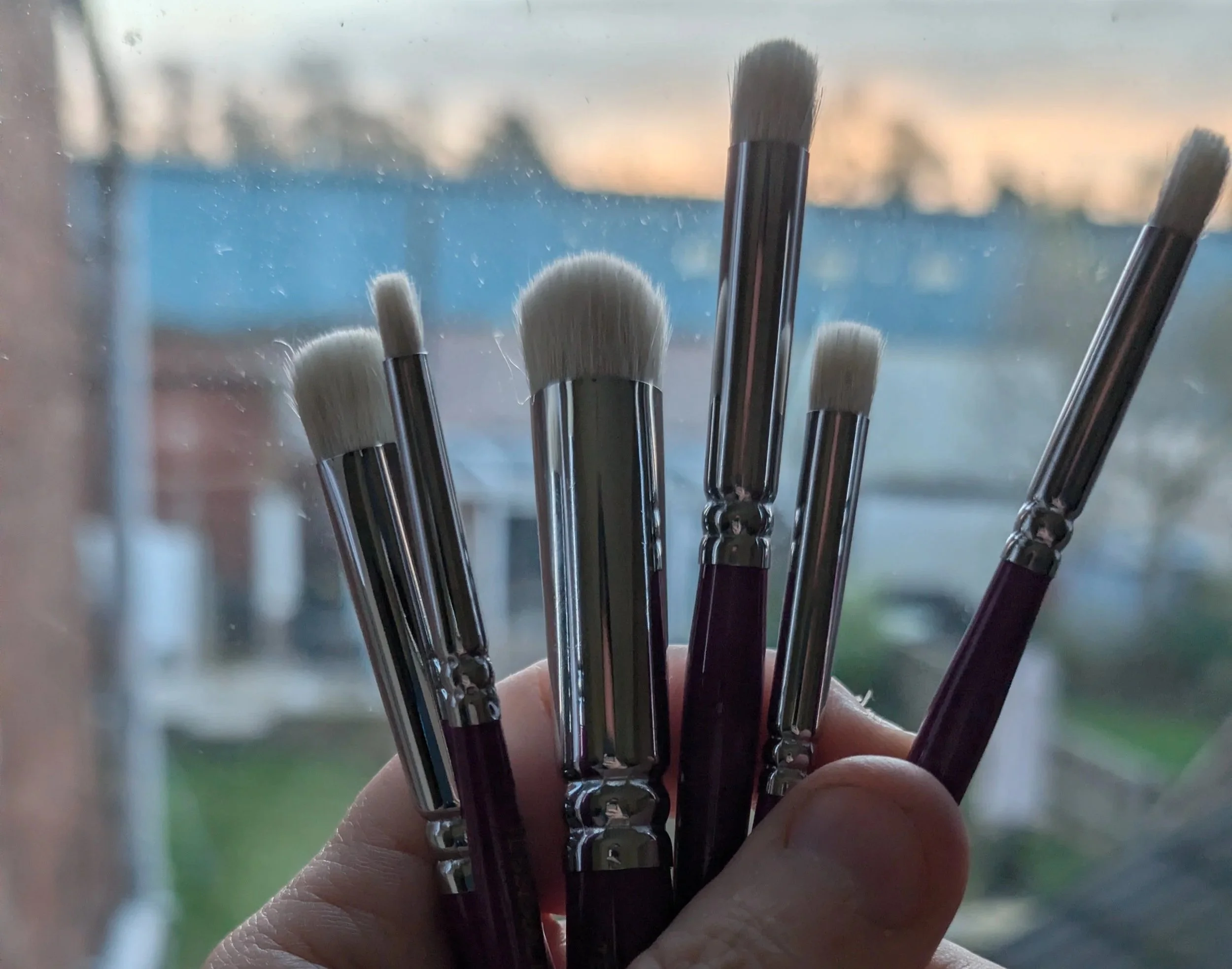
A Hand, Holding Drybrushes
I own a brush brand… (you can buy them on this very site!) as such I have had to EXTENSIVELY quality control and prototype my products, and when I first went in to this game both the “common” and “insider” knowledge that miniature painters share, was essentially everything I had to go off.
I know, shock horror… I’m not from a long line of artisan brush makers, who individually tease virgin pubic hair in to perfect painterly poke-sticks. I am a normal dude, who loves miniature art and wanted to be a part of the thing that has given him so much joy, for most of his life.
But it was starting from this knowledge base, the same knowledge base that you (most likely) have access to right now, that my testing and iteration started to expose just how much we’re getting wrong.
So… if you’re someone who likes to feel special and insidery, or if you’re someone who likes to not waste their money, I have a little Christmas gift from me, to you… some honest, agendaless and actual insider knowledge, from a guy who’s name and livelihood are tied to paint brushes.
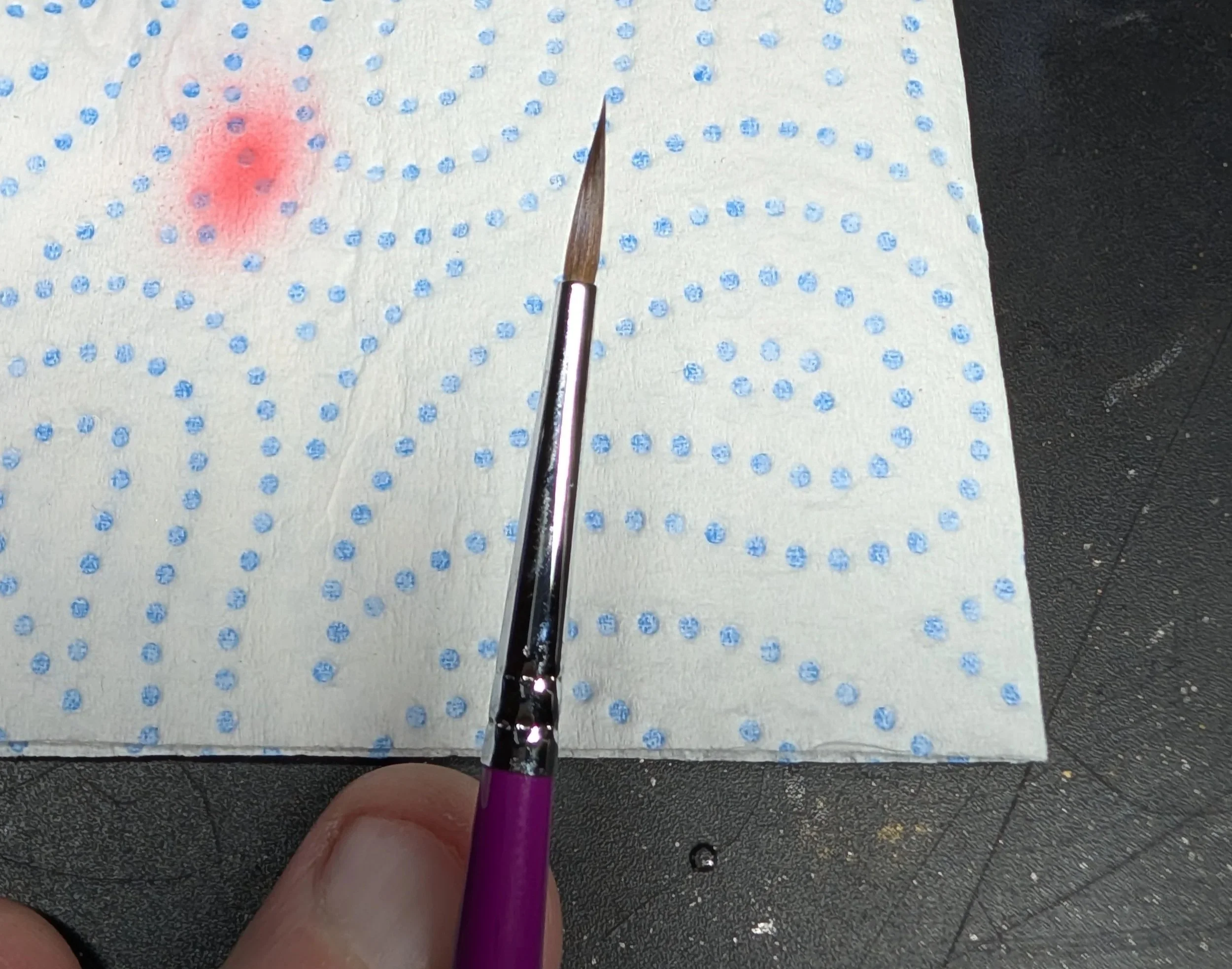
a Relatively New Paint Brush
The brush in the image above iiiiis pretty much brand new. I took it out of it’s packet about 3 days before sitting down to write this, so you’re seeing it in a pretty similar state to how it started its life, with a total of about 20 hours on it, currently.
Something you’ll notice, hinted to by the red splodge on my tissue, is that the brush has already started to develop a tiny bit of red staining. That’s going to be important later, so whilst you’re admiring my hair wand, I want you to also bank that thought.
In choosing to tackle brushcare as a topic, there’s not only a lot of risk to me… but also a MOUNTAIN of subtopics I have to think about, collate and order by importance, to decide how to lay this article out. The first thing I want to talk about is the daily care, the per-session actions you need to take to maximise how long your brush lives.
Those actions are: Rinse it THOROUGHLY and dry it even MORE thoroughly… I cannot stress this enough. The single most important thing you can do to prolong brush life is proper drying . I want those hairs positively arid, soldier. Now jump-to!
Now that probably sounds a bit odd right? And this is exactly what I mean about how far the established knowledge has drifted from reality… because I'll bet you’ve heard a LOT that you should ideally soap your brushes after every session, even if briefly?
If you’ve paid any attention to brushcare advice you’ll have certainly been told to clean them with soap frequently, and you’ll probably have been told to do this in gentle sweeping motions through the puck, with regular rinses in the brush pot.
Wrong, wrong and wrong. This is all terrible advice, and when we think about it we don’t even need to go in to science (although science is on my side here), we can just stop at good ole common sense, to understand why.
Just think back to when you last washed your hands with soap. Once you dried them off, did you notice how dry your skin was? Unless you’re using one of those fancy moisturising soaps, you’ll certainly notice now that I’ve said it.
Soap is a DEEP penetrating chemical product that breaks down oil - AKA a detergent. The job of soap isn’t actually to clean, it is to remove the grip that grease creates on a surface allowing particles to stick to it, so that you can then rinse those particles off. Soap is also not a sanitiser, which is why most hand soaps contain antibacterial formulas. Funny enough, this is stuff I learned at college when I was training my advanced food safety certificate.
This is exactly why the best brush soaps tend to actually be quite low in soap itself, being far more skewed towards conditioner to keep the hairs soft. We want a degree of oiliness in that brush, or the hairs will dry out and subsequently they’ll splay and become hard to control and reshape. Again, this is a fact you can easily back up with common sense.
Look at the best brush soaps out there, the tried and tested brands that have been on the market forever… you’ll find that they’re actually not that keen on forming a soapy lather. They take quite a lot of agitation to start to form that creme texture that you expect of soap. This is exactly because the soap content is fairly low. Masters and Broken Toad are the top two that spring to mind, although the latter company isn’t trading any more so I really only recommend one… but I’ve not tried them all, a fact I'll readily admit to.
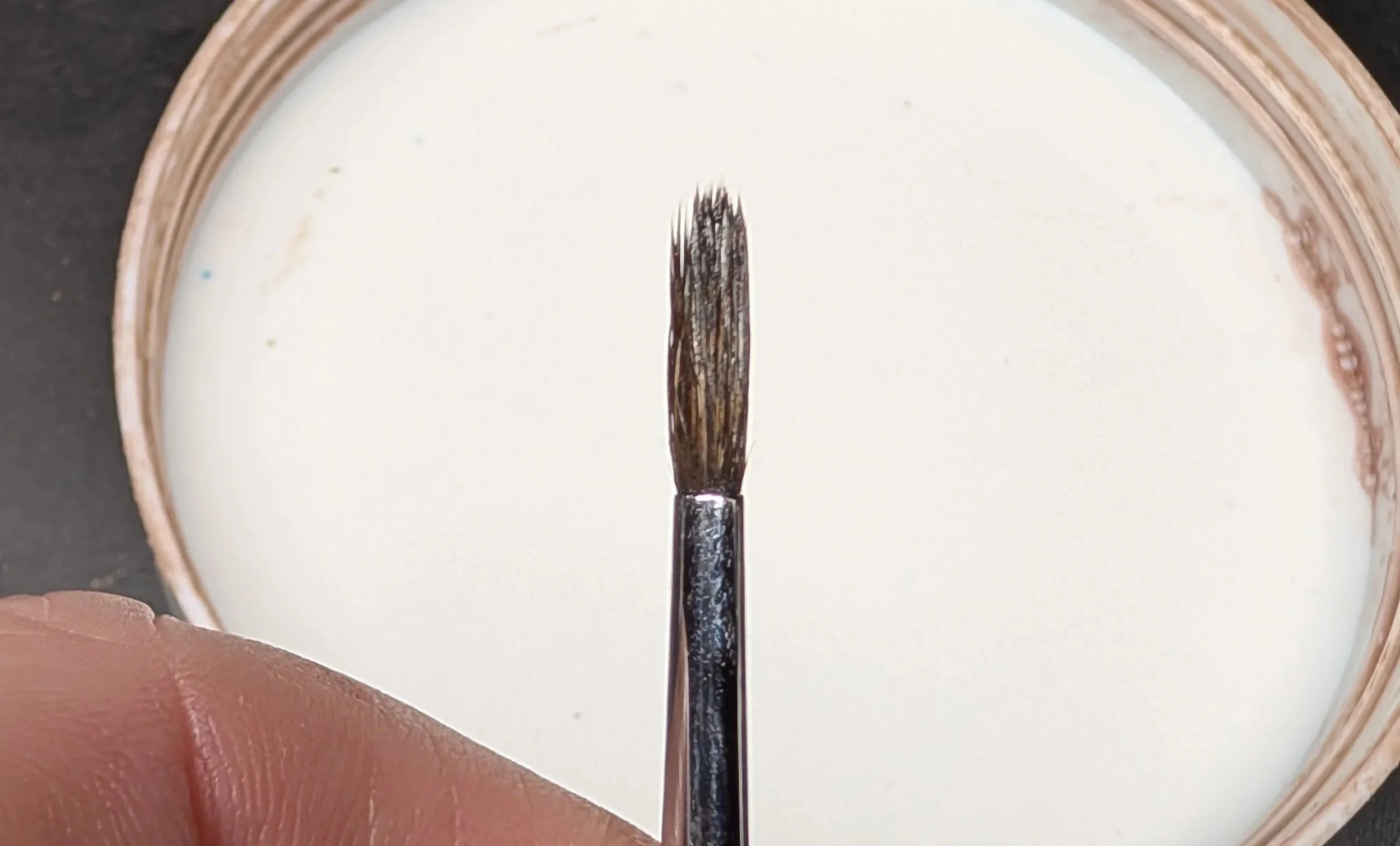
a very dirty, wet brush
The next image (above) is a dirty brush - or at least, what I have come to view as one. There’s significant bristle staining (this ones used a lot of black and brown), there’s visible particulate stuck to the brush. Also this brush is wet and it isn’t naturally falling towards anything resembling a point.
In cleaning this brush, we first need to understand our objectives. What we DON’T want to do is remove the staining. If we apply enough soap to this to remove the staining, we’re going to strip those hairs bare. Dead hair doesn’t oil itself, like it does when its on the animal. It is our job to maintain the moisture content in the hair. Remember the thought I asked you to bank earlier?
What we DO want to do is soften the hairs so they’ll fall back to a point, and we want to remove the particulate, so we don’t get bobbly bits in our paint. Now a little soap can help us with this. Not only will it help us wash away particulate, but it’ll also “open the pores” in the hairs a little, allowing the moisturising and conditioning components of our soap to get in there a bit better. I use quotes because they don’t actually go INSIDE as such and hairs don’t have “pores” so to speak, but the phrasing is a good visual for what’s actually happening.
We’ve established therefore that a low soap soap is what we want. Something with moisturising and conditioning elements to it. But we also need to discuss how to use it. To do this, I first want to show you my soap puck.
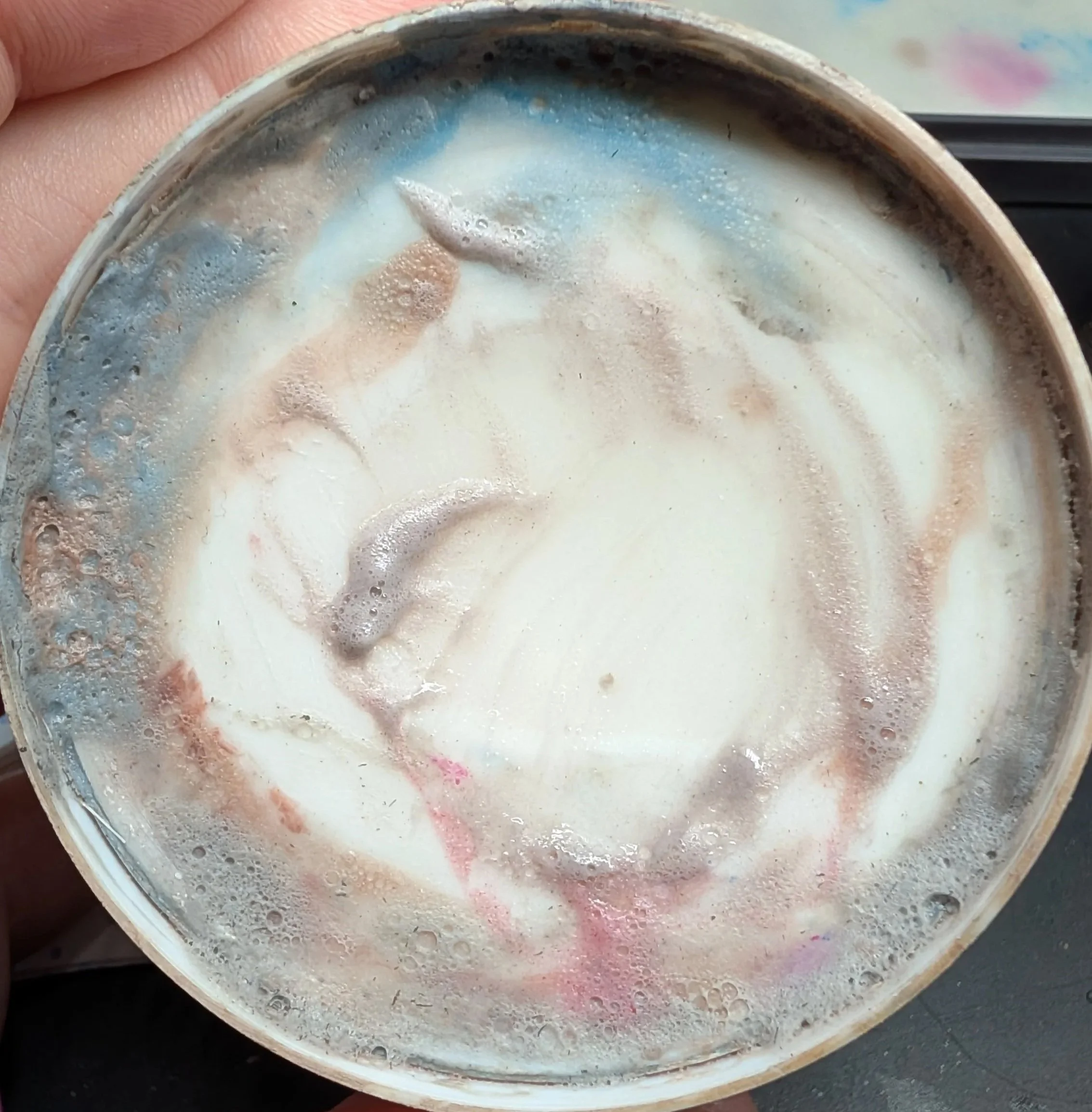
a dirty puck of brush soap
First thing I need to point out here is that I REALLY need to clean my puck, this is about the dirtiest I let it get, but I specifically wanted to show you this worst case scenario.
Lets take a closer look at whats going on in there now…
Most importantly, look near the middle - the area I use most. It is comparatively very clean, even when the puck itself is dirty. This is important.
Also notice that whilst there’s a tiny bit of particulate in my soap, especially round the edges - it’s not full of little grains, like you might expect for someone who paints 40-50 hours a week.
Instead what you mostly see is dried out suds that have clung on to some loose colour. These are important telltale signs that the soap is being used correctly.
Firstly because what we should be doing is working the soap in with our fingers, not by gently sweeping the brush through it. Initially, scrub the wet brush (not too hard) in a circular motion, round the centre of the pot, to pick up some soap. Then get it out of there and use the crook of your forefinger and the flat of your thumb, to massage the soap in towards the centre.
Next, we should be rinsing not in our paint water, but under a running, cold tap. Always cold.
We can repeat this a couple of times if we need to, but again, I stress, don’t overclean. You won’t remove staining without using something too harsh for brushes, or without over washing them. Do this maybe once a week, probably more like every two weeks.
The purpose of the massage and the use of a running tap are to do with the anatomy of a brush, and I want to go on a little sidequest now to understand that anatomy, so as to better inform the rest of the conversation.
A brush is made by first bundling hairs and teasing them by hand. The tail of the bundle is then flattened, dipped in a water based glue and fed in to the ferrule. The ferrule is clamped tightly to both the rod and the hair bundle and the brush is then finished by shaping and setting the head.
Inside that ferrule, the hairs around the middle have the most pressure on them and as such sit the straightest, the hairs around the outside are a little less pressed and so aren’t quite as dense, however overall everything is still very tightly packed, because it is this mechanical pressure that actually holds the brush together.
As such the ferrule of the brush (thats the metal bit btw) has long been identified as the weak point of the brush, where bad care will cause issues and this IS true…but has been COMPLETELY misunderstood by miniature painters, bye and large.
I said understanding this anatomy would help inform why rinsing in running water is important and that’s because actually, the biggest killer of brushes is very much a hidden enemy. It’s your paint water. Hence also my stress on drying thoroughly.
There’s this (frankly quite weird) idea that if you load your brush all the way to the ferrule, it’s the single worst thing you can do and will lead to your brush immediately exploding in your hand. This is not accurate, but it is BASED on some smart thinking.
The density of the hairs in the ferrule is high enough that something as viscous as paint is NOT penetrating them significantly. Hell, washes and contrast paints aren’t even likely to make it that far in (which is why I don’t tell people to use separate brushes, or synthetic brushes for these products). What CAN get in there however is water. If this water is relatively clean, or at the very least cleaner than whatever is on the brush currently, then the effect is has on the brush is mostly benign. However once that water starts to get densely occupied by floaty paint particles… that’s when our hidden killer is born.
Water IS loose enough to penetrate the ferrule. If it carries a bunch of paint particles in there, those particles will expand as they dry. This eventually causes the metal to physically start to buckle… nothing you can see with your eye, but enough that the hairs are no longer as tightly packed by it. Aaand from there, the stuff that can penetrate in to that most delicate of areas starts to become more varied, and more compounding to the issue as it progresses.
Keeping your brush water clean is ESSENTIAL, and is why I use the 2 cup method (one cup for a pre-wash, one cup for the actual wash), and recommend you do, too. However during cleaning, our water needs to be immaculate, because we are deliberately making our brush vulnerable during this process, in order to benefit its longevity in the long-term.
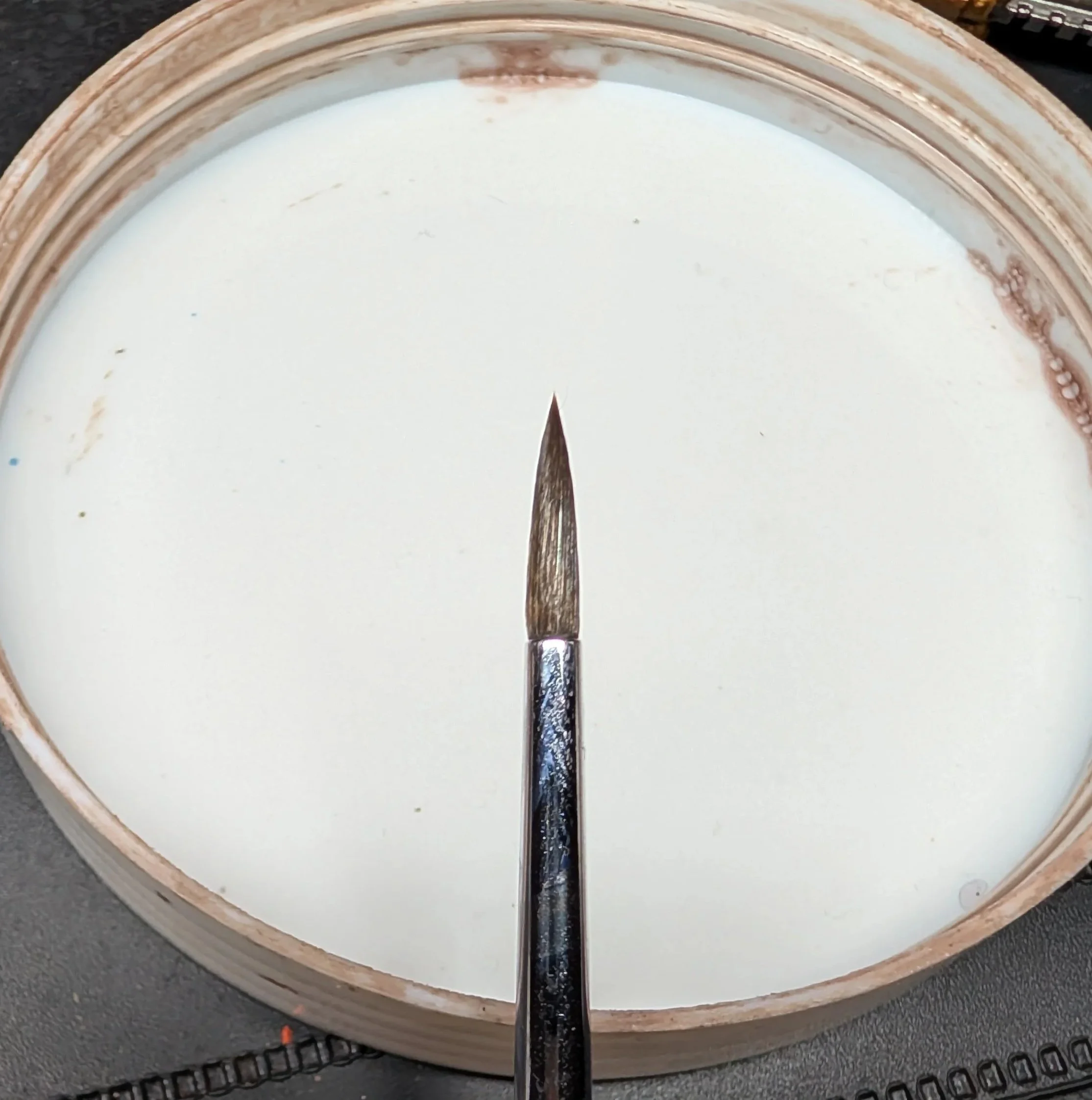
a cleaned brush
Above is that same brush from earlier - the example I used for a dirty brush. That brush is about 8 months old now and after cleaning, look at the crispness of the point!
However also… notice that it doesn’t LOOK sparkly clean. It’s not some Instagram goals photo where I’ve turned a greasy mess into a perfect fresh from packet brush. That isn’t the objective, and shouldn’t be.
The particulate has gone, the hairs are soft again and it comes back to a point. It doesn’t need to win a modelling contest, it just needs to apply paint to miniatures, cleanly. Which it now does.
One of the biggest traps in the pursuit of brush care is having expectations that disagree with best practice and common sense for how to actually improve brush longevity.
This article has been long by design, because when you care about brushes as much as I do, I think it’s important to convey the WHY behind every WHAT that you state, so that you, the reader, can understand why this article is different to the latest ill-informed Instagram trend. However, as a reward for either making it to the end, or being smart enough to skip here, I'll provide a bulleted TLDR now.
DO
Clean your brushes using soap
Choose a reputable, tried and tested soap
Dry your brushes like your life depends on it
Remember to share this article
DON’T
Clean in the soap puck itself
Forget to use running water
Forget to massage the soap in to the bristles
Clean too often
Use products intended for human/animal hair
Use hot water
Stress over paint in the ferrule
Expect a pristine brush after cleaning
Forget to share this article
As a closing note, if after reading this you feel like I’ve changed your mind, or taught you something you didn’t know, PLEASE don’t go seeking out people who have given out contrary information and attacking them.
Yes, there is information out there that is propagated in order to serve an agenda, or profitability of a business… it exists. However I truly believe that people who share brushcare tips are almost universally people who are trying to help out other artists, and if they DO share a falsehood, are doing so because they don’t know any better.
With all that said, thanks for reading - I hope you all appreciate me for writing an article that will directly lead to me selling fewer brushes (since your TMS brushes should last you AGES if you follow my advice)…aaaaaaand…
MERRY CHRISTMAS!
Have a lovely festive season, whether you celebrate for religion, family, friendship or just a good ole pissup. It’s a wicked time of year, and I hope you all spend it happy and safe.
Cheers,
Stu